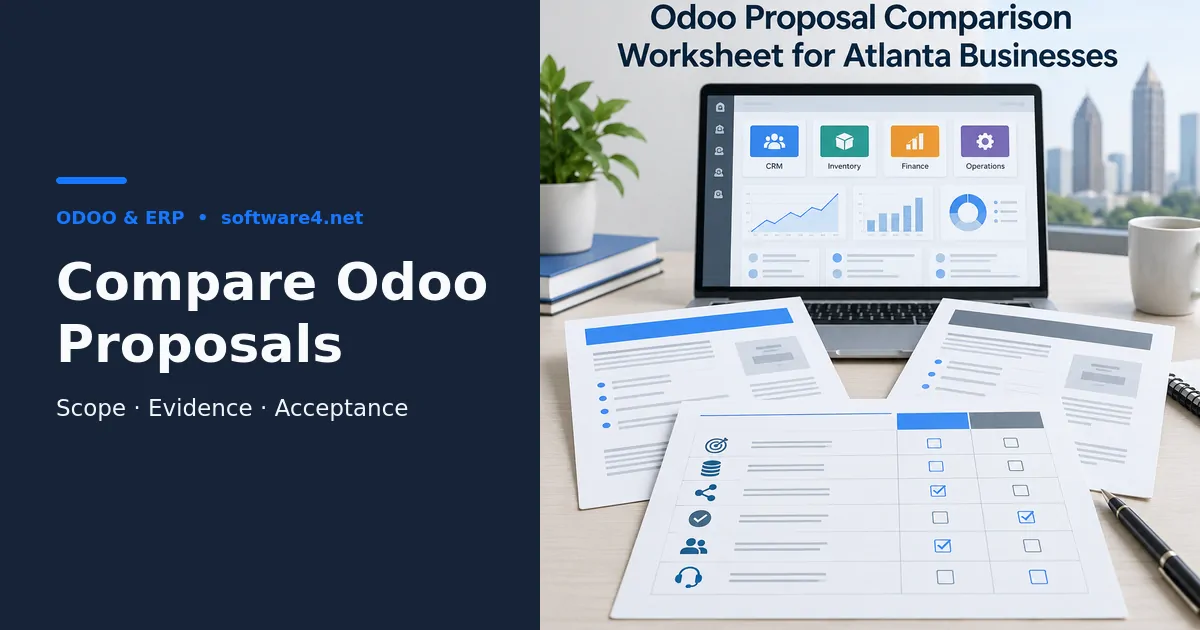
Comparing Odoo proposals is easier when every provider responds to the same requirements. A lower headline estimate may cover different work, assumptions or support. This worksheet helps Atlanta-area teams record those differences before choosing an implementation approach. It is a planning aid, not a price benchmark or a guarantee of project outcomes.
Use our existing Odoo implementation partner questions for the shortlist interview. Use the worksheet below after you receive written proposals: its purpose is to make scope, evidence and acceptance criteria comparable.

Start with one shared project brief
Give each provider the same brief and date it. List the workflows you want to improve, the systems you intend to keep, the records to migrate and the people who can approve decisions. Separate essential launch requirements from later options. Do not include passwords or identifiable customer records in an initial proposal request; use redacted examples where possible.
For a Metro Atlanta distributor, the brief might describe order entry, purchasing, warehouse receipts and invoicing. For a service business, it might focus on CRM, projects and billing. These are illustrative workflows, not Software4 client results or a claim that every function is included in every Odoo edition.
Copy this comparison worksheet
Create one copy for each proposal. Record the proposal version, date, provider and internal reviewer. For every row, write the exact included deliverable, the exclusion or assumption, and the evidence still needed. Use “not stated” for missing information; do not treat a blank as included.
| Review area | What to record from the proposal | Evidence to request before agreement |
|---|---|---|
| Business workflows | Named processes, launch priorities and exclusions | A walkthrough using your representative scenario |
| Edition and deployment | Odoo edition, version, hosting and required applications | Confirmation that the proposed environment supports the requirements |
| Configuration and custom work | Standard configuration, custom modules and third-party components separately | Written justification and maintenance responsibility for each custom dependency |
| Data migration | Record types, source systems, cleanup ownership and rehearsal scope | Mapping rules, reconciliation checks and treatment of rejected records |
| Integrations | Systems, direction of data flow and responsibility boundaries | Error handling, duplicate prevention and support ownership |
| Testing and acceptance | Test scenarios, business reviewers and sign-off criteria | An acceptance checklist with unresolved defects recorded |
| Training and handoff | Roles covered, delivery format and documentation | A sample agenda and a list of handoff materials |
| Commercial scope | Implementation, licensing, hosting and optional work separately | Dated assumptions, exclusions and a change-approval process |
| Launch and support | Cutover responsibilities, support coverage and escalation | Written support terms and the process for handing over access |
Odoo's official edition comparison shows that features differ between Community and Enterprise. Check the specific version and hosting arrangement as well. A module name in a proposal does not by itself confirm that every required feature, connector or customization is available in the quoted environment.
Compare like-for-like costs and responsibilities
Keep the quoted implementation amount separate from recurring costs and optional work. Record the currency, quote validity, payment milestones and what the estimate assumes about users, records, integrations and training. Ask the provider to clarify any allowance rather than inventing a total.
If one proposal includes data cleanup and another expects your staff to do it, mark that difference before comparing price. Apply the same approach to test migrations, custom reports, on-site visits and post-launch changes. Do not assume that a local address means travel or on-site support is included. Confirm availability, location and travel terms in writing.
For software and data ownership, record what the proposed agreement actually provides. Clarify licenses, custom-code rights, export access, documentation and transition assistance. Paying for discovery does not automatically establish ownership of every deliverable; the agreed terms matter.
Turn a demo into an acceptance scenario
Choose a representative workflow and describe the expected result before the demonstration. For example: receive an order, check availability, prepare a shipment and review the related invoice. The exact steps depend on configuration. Ask the provider to identify what is demonstrated in the proposed environment, what needs configuration and what remains unproven.
Then define a migration check. Your business reviewer might reconcile opening balances, inventory quantities or a sample of customer records against the approved source. Agree the tolerances and exception process for your project. Record who resolves discrepancies and who authorizes the final cutover.
Our business UAT checklist can help you organize scenarios and sign-off responsibilities. It complements the proposal worksheet; it does not replace testing in your actual Odoo environment.
Keep an unresolved-items log
Do not hide an unanswered requirement inside an average score. Give each unresolved item an owner, a next date and a decision: required before agreement, required before launch, or explicitly deferred. If you use a scoring scale, define it internally and apply it consistently. It is a decision aid, not a prediction of implementation success.
A useful closing record contains the proposal version accepted, the scope agreed, the exclusions acknowledged, the people approving it and the remaining dependencies. Preserve earlier versions so changes remain traceable.
Frequently asked questions
Who should maintain the comparison worksheet?
Name one internal project owner to keep the proposal versions and unresolved-items log together. Ask workflow owners to review the rows that affect their work and record who can approve scope decisions.
Should we reject a proposal with missing details?
First identify which details affect your decision and request clarification. Record them as unresolved until answered. Whether to proceed depends on your business requirements and the terms you agree.
Does a larger proposal mean a better implementation?
Document length does not establish fit. Compare evidence for your workflows, responsibilities and acceptance criteria. A concise proposal can still be clear; a detailed one can still omit a critical dependency.
Can Software4 help define the scope?
Software4.net, operating as Consultwise LLC from Alpharetta, Georgia, offers Odoo consulting, implementation, integration, migration, training and support. Review the Odoo ERP service page, then bring your workflow brief and unresolved items to a discussion. Deliverables, timing, licensing, hosting and ongoing support are scoped for the project; this worksheet does not promise a fixed price, timeframe or outcome.
Prepare for the proposal review
Before your next meeting, copy the worksheet, attach the current brief and highlight the rows that are not stated. Ask each provider to respond to the same version. Your next useful step is a comparable written scope and a clear list of decisions, rather than an unsupported claim that every requirement is already covered.
Source review: Odoo's official edition comparison and Software4.net's current Odoo ERP service information, reviewed November 17, 2026. Recheck product capabilities against the edition, version and deployment proposed for your project.
Ready to discuss your brief? Contact Software4.net with your project stage and the workflows you want to review. Confirm the scope and availability with the team before making delivery plans.